


High-level dialogue showcases lessons from Kenya, Ghana and South Africa on strengthening enabling frameworks, improving coordination and scaling investment for local climate action
Nairobi, Kenya – As the world faces a growing climate finance gap, Africa is no exception. The continent requires an estimated USD 155 billion annually to meet its climate and development goals, yet only around USD 30 billion is currently mobilised each year. The question is no longer whether more finance is needed, but how to ensure it reaches the cities, regions and communities on the frontlines of climate action.
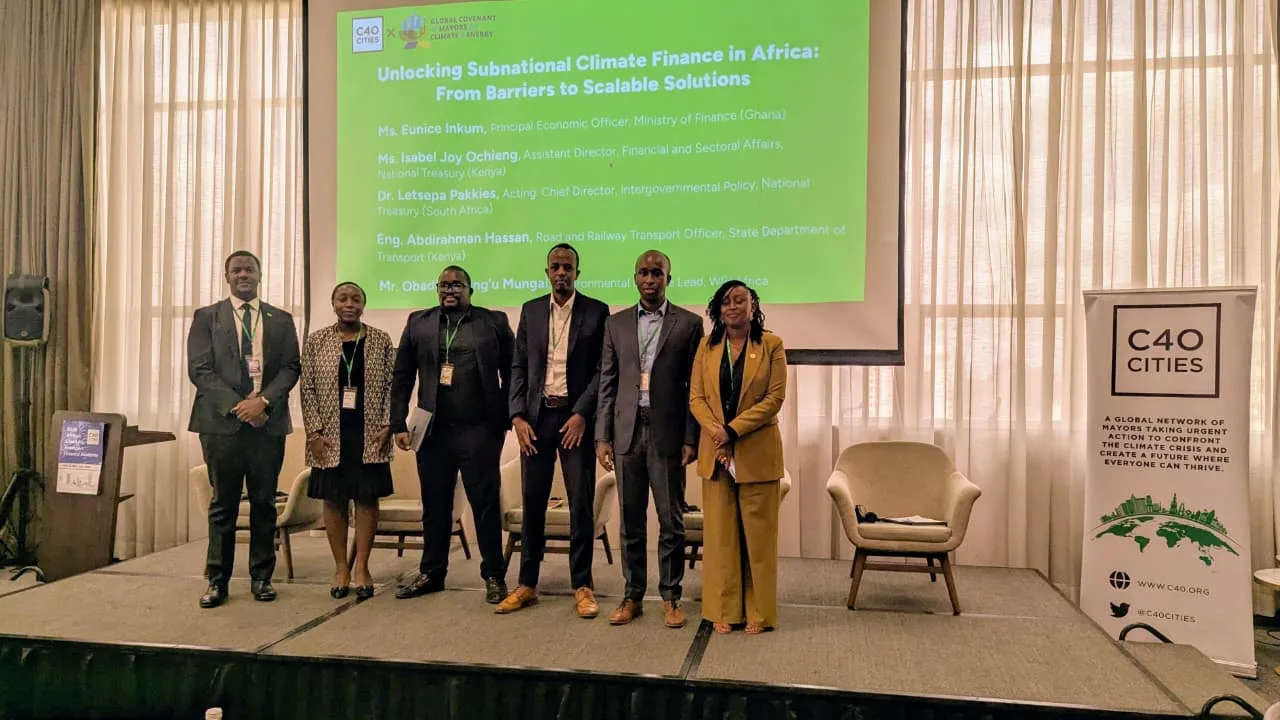
To address this challenge, national and subnational leaders convened during the 2026 Clean Air Transport Finance Academy for the high-level dialogue, “Unlocking Subnational Climate Finance in Africa: From Barriers to Scalable Solutions,” co-hosted by the Global Covenant of Mayors for Climate & Energy (GCoM) and C40 Cities in partnership with the World Resources Institute (WRI), to explore how stronger partnerships between national and local governments can help unlock climate finance and accelerate action where it is needed most.
Closing this gap will require not only greater volumes of finance, but also stronger mechanisms that enable subnational governments to access, manage and deploy affordable climate finance that drives climate action implementation at scale. Local leaders are responsible for delivering many of the infrastructure, resilience and development investments needed to achieve national climate goals. Yet they often face significant barriers, including limited access to financing, fragmented institutional arrangements, and regulatory constraints that restrict investment flows.
Building on growing momentum for multilevel climate action across the continent – including the Open Letter to African Ministers of Finance signed by African mayors and governors during last year’s Green & Resilient UrbanShift Africa Forum in Nairobi – national government representatives, subnational leaders and climate finance experts gathered to examine practical pathways for overcoming these challenges. Discussions focused on strengthening intergovernmental coordination, improving policy and regulatory frameworks, and deploying proven financial mechanisms that can unlock investment for climate action at the local level.
Njenga Muchekehu, C40 Cities’ Deputy Regional Director for Africa, said:
“Last year in Nairobi, more than 40 African mayors and governors came together to send a clear message: cities and regions are ready to lead on climate action, but they cannot do it alone. Through our Open Letter to African Ministers of Finance, local leaders called for stronger national support to unlock the investment needed to build resilient, low-carbon communities. One year later, we are already seeing the impact of that collective advocacy. The conversation has moved from asking why cities need climate finance to identifying how national governments can help deliver it. From reforms underway in South Africa to growing engagement from continental institutions, momentum is building around a shared understanding that climate finance must reach the local level if Africa is to achieve its climate and development goals.”
The CHAMP Coalition high-level dialogue on “Unlocking Subnational Climate Finance in Africa: From Barriers to Scalable Solutions”, convened senior policymakers, city leaders and climate finance experts from across Africa. Participants included representatives from the governments of 2 CHAMP-endorsing countries (Kenya and Ghana) and South Africa, alongside experts from the World Resources Institute (WRI) and delegates from 12 African cities. Speakers included Ms. Hellen Njoki Wanjohi-Opil (WRI), Ms. Isabel Joy Ochieng (Kenya’ National Treasury), Ms. Eunice Inkum (Ghana Ministry of Finance), Dr. Letsepa Pakkies (South Africa’s National Treasury), Eng. Abdirahman (Kenya State Department of Transport) and Mr. Obadiah Kung’u Mungai (WRI Africa), who shared experiences and practical approaches to scaling subnational climate finance across the continent.
Country Experiences: Emerging Lessons from Across Africa
Drawing on experiences from Kenya, Ghana and South Africa, the panel highlighted how national and local governments are already working together to remove barriers and unlock climate finance at scale. While each country is pursuing its own approach, a common lesson emerged: effective subnational climate finance depends on strong national enabling frameworks, clear intergovernmental coordination mechanisms, and financing models that empower local governments to plan, invest and deliver climate action.
In Kenya, a combination of fiscal decentralisation, devolved climate finance mechanisms and private-sector reforms is helping counties access and deploy climate finance more effectively. Initiatives such as County Climate Change Funds and Financing Locally-Led Climate Action (FLLoCA) are creating pathways for local governments to translate climate priorities into investment-ready projects.
Isabel Joy Ochieng, Kenya’s Assistant Director, Financial and Sectoral Affairs, said:
“Kenya’s experience shows that climate finance reaches communities most effectively when national and county governments work together. Through performance-based grants and pooled financing arrangements, we are strengthening counties’ ability to plan, access and manage climate investments. At the same time, reforms to public-private partnerships, investment pipeline development and efforts to improve county creditworthiness are helping unlock new sources of finance and create opportunities to scale local climate action.”
In Ghana, fiscal decentralisation reforms are strengthening the role of local governments in delivering climate and development priorities, while creating a more enabling framework for investment at the local level.
Eunice Inkum, Principal Economic Officer, Government of Ghana, said:
“Ghana is advancing a range of reforms to ensure that resources, responsibilities and decision-making are aligned at the local level. Through the principle of ‘funds follow functions’, increased allocations under the District Assemblies Common Fund, the forthcoming National Decentralisation Policy and emerging tools such as Ghana’s Green Taxonomy, we are creating stronger foundations for local governments to access finance and contribute to national climate and development objectives.”
In South Africa, ongoing reforms are creating new opportunities for cities to play a greater role in climate finance, investment planning and the implementation of national climate priorities.
Dr. Letsepa Pakkies, South Africa’s Acting Chief Director, Intergovernmental Policy, National Treasury, said:
“South Africa’s ongoing municipal and fiscal reforms are helping create an environment where cities can play a stronger role in driving climate action and investment. By strengthening coordination between national and local government, improving planning and financing frameworks, and creating greater opportunities for municipal engagement, we are working to ensure that climate finance can be deployed more effectively where it delivers the greatest impact. These reforms also offer valuable lessons for other countries seeking to strengthen multilevel climate governance.”
While the institutional and financial contexts differ across countries, the experiences shared during the dialogue demonstrated that subnational climate finance does not happen by accident. It requires deliberate action by national governments to create enabling policies, strengthen local capacities, improve coordination, and establish financing mechanisms that channel investment to where climate action is actually delivered.
As African countries seek to close the climate finance gap, the lessons emerging from Kenya, Ghana and South Africa provide a practical roadmap for scaling local climate action and building more resilient, sustainable communities across the continent.
Guidance on how to Increase Finance for Subnational Climate Action
Last year’s Green & Resilient UrbanShift Africa Forum in Nairobi C40 Cities and the Global Covenant of Mayors for Climate & Energy (GCoM) launched a practical guide for national governments participating in the Coalition for High Ambition Multilevel Partnerships (CHAMP), outlining implementation options, proven financing approaches and coordination mechanisms to help increase finance for subnational climate action.