







- David Benac’s Rainforest Radicals traces how Rainforest Action Network grew from a small San Francisco-based activist group into an influential force in rainforest protection, Indigenous rights, and corporate accountability.
- The book follows RAN’s early campaigns against Burger King, True Geothermal, the World Bank, and Mitsubishi to show how the group linked distant forest destruction to everyday choices, public pressure, and corporate reputation.
- Benac shows how RAN combined decentralized organizing, nonviolent direct action, media spectacle, boycotts, and long-term support for local and Indigenous-led campaigns.
- The interview explores what RAN’s history can teach today’s environmental movements about leverage, persistence, outside solidarity, and the challenges that come when a radical network begins to win.
When Rainforest Action Network began in 1985, it had little of what usually makes an organization powerful. It had no large budget, no legal department, no reliable access to politicians, and no formal way to force global corporations or development banks to change. It had Randy Hayes, a wide activist network, a way to connect distant forest destruction to everyday choices, and a willingness to use tactics that many mainstream environmental groups avoided.
David Benac’s new book, Rainforest Radicals: A History of Rainforest Action Network and Transnational Organizing, tells the story of how that combination became effective. RAN’s early campaigns targeted Burger King over rainforest beef, True Geothermal in Hawai‘i, the World Bank over development projects, and Mitsubishi over tropical timber. These were different fights, involving different places, institutions, and coalitions. Together, they show how a small San Francisco-based group helped bring tropical deforestation, Indigenous rights, and corporate accountability into late twentieth-century environmental politics.
Benac, an environmental and public historian of the postwar United States, came to the subject indirectly. He was researching timber-industry history in the Pacific Northwest when he encountered the MacMillan Bloedel papers and a grassroots campaign against clear-cutting in British Columbia’s coastal rainforests. RAN appeared in the archival trail. That led him to Hayes, RAN’s co-founder, then to a larger oral-history project with activists, allies, and contemporaries. The result is a history built around interviews, archives, and a close look at how people organize when formal institutions offer little help.
RAN’s early thinking drew from Earth First!, Greenpeace, Friends of the Earth, and Australia’s Rainforest Information Centre. The group borrowed from each, adapted their methods, and developed its own identity. It used nonviolent direct action, boycotts, media spectacle, and decentralized organizing. It also placed Indigenous self-determination near the center of its mission, at a time when many national environmental groups still treated forests mainly as ecological spaces rather than homelands, cultural landscapes, and political territories.
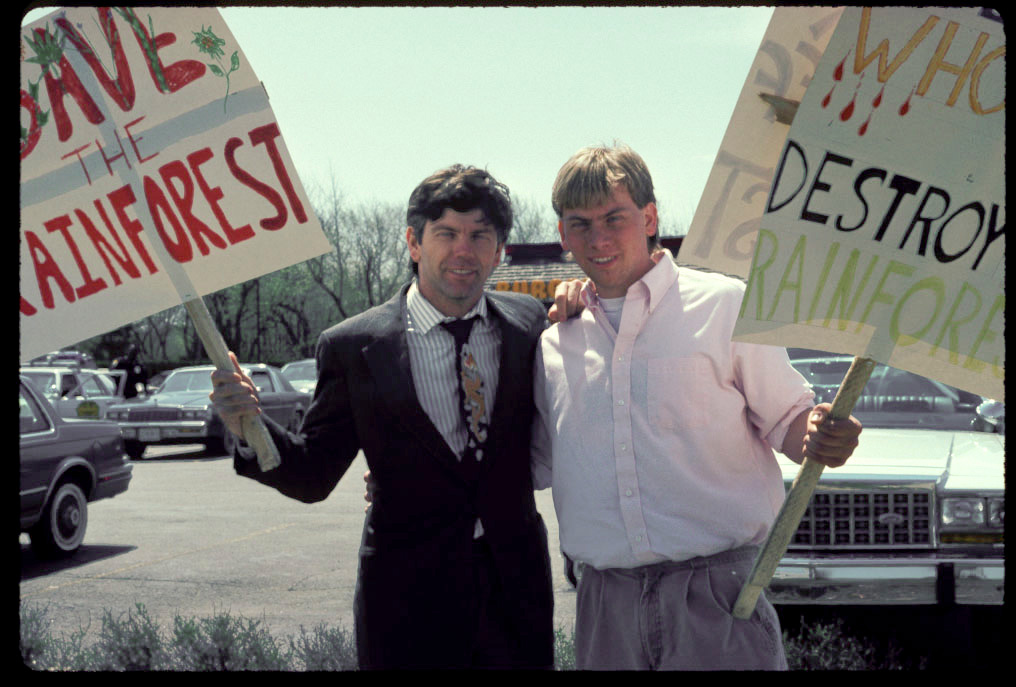
For RAN, “radical” did not simply mean dramatic protests or a taste for confrontation. It meant trying to identify the causes of tropical deforestation. The group saw forests being cleared through a system that linked multinational corporations, banks, governments, consumer demand, and development policy. Its campaigns were aimed at pressure points within that system. A hamburger chain, a geothermal company, a development bank, and a sprawling Japanese conglomerate became ways to make a global problem visible to people who might otherwise encounter it only as a distant issue.
Visibility mattered. RAN was good at theater. Its activists wore costumes, staged banner drops, organized boycotts, and used humor to keep campaigns from becoming grim exercises in moral instruction. In one of the book’s memorable scenes, activists at a Home Depot protest used the store’s own intercom system to direct shoppers toward rainforest-linked products. The action worked because it translated distant destruction into a consumer setting. It gave shoppers a way to see the link between everyday purchases and forests far from the store aisle.
The organization’s structure mattered as much as its style. RAN relied on Rainforest Action Groups, or RAGs, which operated with considerable independence. Local groups could choose tactics suited to their members, provided they stayed within broad guardrails. That flexibility allowed RAN to hold together a wide range of people, from cautious public-education groups to more confrontational campus organizers. It also allowed national campaigns to appear local, repeated, and persistent. A corporation could ignore one protest. It was harder to ignore a network that could show up in city after city, year after year.

Benac is attentive to the tensions this created. Charismatic founders can energize movements, while also leaving organizations dependent on personality. Grassroots freedom can build commitment, while also making coordination difficult. RAN’s early history is therefore not presented as a simple success story. The qualities that gave the group force also produced instability, conflict, and questions about how a radical network should mature once it begins to win.
The campaigns involving Indigenous communities add another layer of complexity. Benac emphasizes that RAN’s work was most credible when it responded to requests from local and Indigenous groups rather than imposing its own agenda. The Hawaiian rainforest campaign, led by Native Hawaiian organizers with RAN and others in supporting roles, shows both the usefulness and the limits of outside solidarity. Outside allies could bring media attention, money, legal help, and organizing experience. They also had to contend with mistrust rooted in long histories of extraction, colonialism, and self-serving intervention.

Many environmental debates today still turn on leverage: who has it, who lacks it, and how public pressure can be built when governments move slowly or unevenly. Benac does not suggest that RAN offers a ready-made model for today’s climate and biodiversity movements. The political, media, and legal landscapes have changed. Civil disobedience carries different risks. Corporations have become more sophisticated at absorbing criticism. Even so, RAN’s history remains useful because it shows how strategy, persistence, coalition-building, and sustained pressure can give small groups a role in fights usually dominated by larger institutions.
In the interview that follows, Benac discusses how RAN emerged, what made its campaigns effective, where its radicalism came from, and what today’s movements might learn from its achievements and limitations. The story is about rainforests, but it is also about organizing: how people find leverage, how they sustain pressure, and how movements decide what kind of power they are willing to use.

An interview with David Benac
Mongabay: What is your background and how did you decide to become a professor of history?
David Benac: The foundations for my academic career and my passions were forged in my youth on a homestead in rural, northern Michigan. It was a life intimately connected to the land. Through faming, woodwork, hunting, fishing, and camping, I developed a deep connection to the place. In later years, living in Indiana, Missouri, Louisiana, and several areas in Michigan I found natural areas that inspired me intellectually and emotionally.
I entered college as a history major because I loved to read, found the natural sciences and history fascinating, but struggled with math. The pieces came together when I discovered environmental history in my last year as an undergraduate. Ever since, I’ve been working to understand how people’s relationships with the land change over time and how they respond when those relationships are threatened.
Mongabay: What first drew you to Rainforest Action Network as a subject, and when did you realize it could carry a full book?
David Benac: I was doing research at the Forest History Society’s archives on a project about the ways residents of former company-owned sawmill towns in the Pacific Northwest commemorated the timber industry when I came across the Macmillan Bloedel papers. One of the central topics in the collection was a grassroots campaign that challenged the company’s clearcutting of coastal rainforests of British Columbia. I’d already done several oral histories with timber workers and dug deeply into the Timber Wars, but this was different. This was a story of an Indigenous-led, grassroots campaign that used a wide array of tactics to win protection for a culturally and ecologically significant forest.

RAN appeared to be the primary US-based organization involved, and I wanted to know more. In the process I learned that Randy Hayes (founder of RAN) was living in D.C. When the opportunity came up to participate in a conference in the area, I sent an email to Hayes to see if he’d sit with me for an oral history. I was surprised when he agreed. His stories sold me on the topic and after about 10 interviews with him, about two dozen with other RAN leaders and contemporaries, and a research stint in the RAN papers at the Bancroft Library at UC Berkely, it was clear that there was more than enough for a book that would have real value.
Mongabay: You describe RAN as both radical and strategic. What did “radical” mean in the context of RAN’s early years?
David Benac: RAN’s most significant influences were Earth First!, Friends of the Earth, Greenpeace, and Rainforest Information Centre, as well as Cultural Survival and Survival International. That put RAN in pretty radical territory. Defining RAN’s radicalism was something every interviewee volunteered in a way that positioned it as central to the organization’s identity. The definitions followed two paths, tactics and ideology. The interviewees all considered RAN’s embrace of human rights, challenge of corporate-led global capitalism (a frequently used term), and willingness to demand systemic changes as the radical foundation. Interviewees conceived of RAN’s tactics on a continuum of radicalism. RAN’s grassroots, confrontational, and mediagenic tactics put it near Greenpeace on the radical side, but fundamentally distinct from the monkeywrenching of Earth First!.
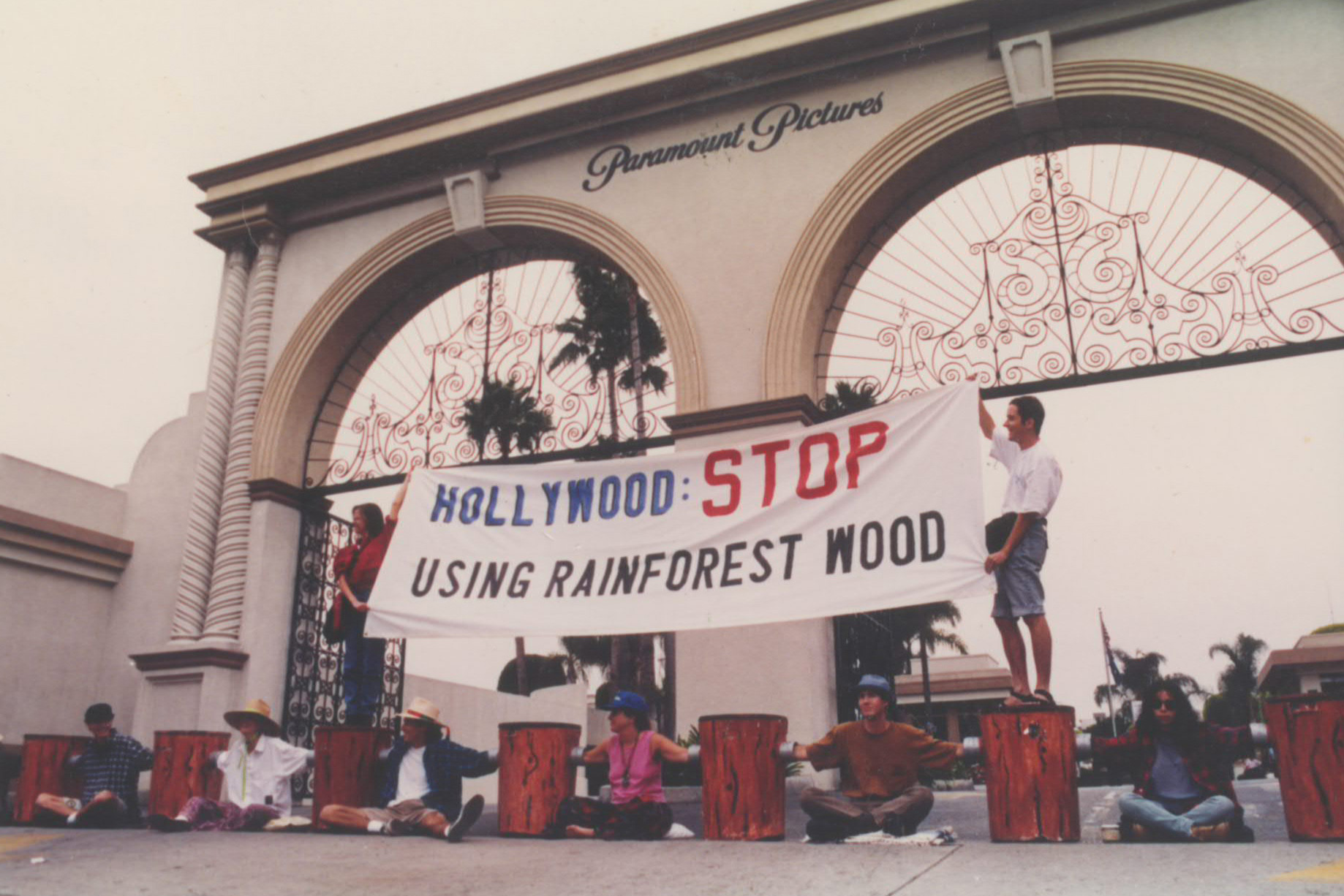
Almost all interviewees began their definition of radicalism by referencing the Latin, radicalis, as meaning having roots and getting to the roots of an issue. This was RAN’s radicalism. The source of tropical deforestation and the associated violations of human rights was the collaboration of multinational corporations, development banks, global institutions, politicians, and bureaucrats in a reckless pursuit of self-interest. None of the problematic actions were isolated incidents or aberrations from the norm. The root problem was the global systems that incentivized such behavior. A tweak, correction, or mitigation was not a solution. RAN advocated for a world in which the rights of forests and Indigenous communities to exist could not by converted to wealth for corporations, bankers, or politicians. RAN’s tactics and organizational structure were innovative, and often radical. The ideology, was radical.
Mongabay: RAN’s campaigns often targeted large corporations rather than only governments. Why was that approach important at the time?
David Benac: Hayes argues that the prospect of political solutions vanished when Carter failed to win reelection to the presidency. That was partially correct. Carter’s more progressive efforts had fallen away by the second half of his presidency. That timeline, as elaborated by many historians, corresponds with final defeat of 1960’s idealism by the forces of greed and corporate power. Two developments from 1971 that deserve mention are the U.S. Supreme Court’s decision in Buckley v. Valeo and “The Powell Memo” by Lewis Powell of the US Chamber of Commerce. Buckley v. Valeo was the first step in selling our government to the highest bidder. With his memo, Powell defined the step-by-step strategy that fueled the conservative takeover of the Federal government. 1971 set the stage for the rise of Reagan and the Clintonian redefinition of the Democratic Party.

The radical, neoliberal capture of the government forced the advocates of nature, human rights, and democracy to follow the few paths remaining, grassroots organization, civil disobedience, and direct action. By the time of RAN’s emergence in 1985, it was obvious that in the face of corporate cash and power, politicians were corrupt, complacent, or cowardly and could not be counted on to rein in the abuses perpetrated by the economic elite of the Global North.
Mongabay: The book follows four major campaigns: rainforest beef, Hawaiian rainforests, the World Bank, and tropical timber. Which of these surprised you most as you researched it?
David Benac: Each campaign offered surprises. The rainforest beef campaign revealed how closely RAN was tied to Earth First!. Rather than a grassroots version of Greenpeace, RAN emerged as a rainforest-centric version of EF!, minus the monkeywrenching. The Hawaiian rainforest campaign exposed the toxic secrets of geothermal. As Barry Commoner argued, there is no free lunch.

The surprise in RAN’s World Bank work was the predictability of how the Bank’s actions led to environmental destruction and attacks on Indigenous and traditional people from Peru to Papua New Guinea. Infrastructure projects, primarily large hydroelectric dam complexes, required the forced relocation and criminalization of Indigenous people and international loans that crippled national economies and the liquidation of natural resources, especially tropical forests. The surprise of the tropical timber campaign was how RAN’s meteoric rise abruptly collided with a new global reality at the dawn of the 21st century. A second surprise of the campaign, was the sheer scale of Mitsubishi and RAN’s ability to extract a (qualified) win from the global juggernaut.
Mongabay: RAN lacked the money, legal power, and political access of the institutions it confronted, yet it still won concessions. What made that possible?
David Benac: RAN’s success is difficult to condense into a single point, or even a few attributes. Novelty was part of the story. Rainforest conservation, coupling human rights with environmental advocacy, the use of boycotts, and coordinated acts of civil disobedience by a dispersed grassroots network were all new to national-level environmental organizations (with the exception of Earth First!) in the United States. This freshness was attractive to activists and media, and forced corporations and institutions to adapt.

The organization was fueled by its structure as a true network that empowered organizers to feel that they were part of a community of purpose where all were valued and able to pursue strategies that fit their local group and had a voice in directing campaigns. RAN also benefited from Hayes’s willingness to collaborate, share credit, and learn from others. Probably the simplest attribute that fed RAN’s success was persistence. Almost every major campaign took five or more years before yielding results. The secret of RAN’s unusual level of success was, in large part, its ability to unite a wide variety of grassroots group through a commitment to direct action, systemic change for the good of people and ecosystems, and a multi-year campaigns.
Mongabay: The book pays close attention to grassroots groups and local affiliates. What did those local networks allow RAN to do that a centralized organization could not?
David Benac: RAN established guardrails (no violence, no monkeywrenching, keep a hard-nosed approach, demand rainforest protection that respects the needs and desires of indigenous and traditional communities) then allowed Rainforest Action Groups to adopt tactics and join the campaigns that spoke to their members. This strategy built a network of over 200 local groups with an incredibly diverse set of ideologies.

Chicago illustrates how the distributed, grassroots structure provided space for everyone who wanted to get involved. The Chicago RAG, ensconced within the city’s “Gold Coast,” was the most significant in the city and one of the most tactically conservative in the entire network, as revealed in its mission statement: “CRAG aims to increase public awareness of the dangers of rainforest destruction, raise money to protect endangered rainforests, and suggest practical steps toward conservation of these precious natural resources.” About nine miles to the south, the University of Chicago RAG reported a very different mission statement: “Fuck Shit Up.” A centralized organization that controlled the constellation of available tactics would never have been able to unite those two groups, or others from Lubbock, TX, to Boston, MA. The diversity within the RAG network meant that RAN could create pressure from a seemingly infinite number of angles. When RAN called for days of action the network mobilized and made rainforest conservation nationally visible from small towns to the largest metropolises, created coordinated pressure at every retail outlet of target corporations, and allowed participants to see themselves as part of a large and powerful community with a shared vision for a better world.
Mongabay: How did RAN’s commitment to Indigenous self-determination shape its work differently from other environmental groups of the period?
David Benac: During RAN’s early days there were environmental groups and human rights groups, but at the national-scale in the US, there was functionally no overlap. There were environmental groups, such as Greenpeace, inspired by a funhouse-mirror version of Indigenous ideology that were years away from incorporating Indigenous rights in their efforts to protect spaces those folk had occupied for generations. Indigenous rights began to appear in the messaging of environmental Big Nongovernmental Organizations (BINGOs) by 1990. The big difference was the approach.

RAN’s reputation as a supportive partner resulted in frequent requests for assistance by Indigenous communities. The rainforest beef campaign, RAN’s first, was the last that the organization joined without first being invited by an indigenous or local grassroots group. When the Natural Resources Defense Council was advocating for more regulation of the oil industry in Ecuador, RAN sided with the Huaorani calling for Texaco’s expulsion from the tribe’s ancestral lands and the complete cleanup of the corporation’s toxic waste. When the World Wildlife Fund was working with international financiers and the Bolivian government to engineer a debt-for-nature swap that offered no real protections and undermined Indigenous access to the rainforest, RAN pushed its “Protect-an-Acre” program to directly send money raised by RAGs like those in Calgary and Houston to Indigenous communities to protect and establish legal title to traditional lands. RAN’s most significant statement of principle was a message given to Hayes while he lived with the Hopi: Go back to your culture, work to take industrial civilization’s foot off the throat of Indigenous cultures and support the work of Indigenous communities to shape their own destiny.
Mongabay: The Hawaiian rainforest campaign seems especially complex because it involved ecology, culture, religion, land rights, and energy politics. What did that campaign reveal about the strengths and limits of outside support?
David Benac: A critical component of the campaign was that it was initiated, led, and shaped by Native Hawaiians, especially the Pele Defense Fund. Other Hawaiians and mainlanders primarily occupied supporting roles. Hawaiian organizers understood the spiritual and ecological value of the threatened places, the multi-faceted pollution produced by geothermal wells, and the infrastructures of power pushing the developments. Outsiders, such as RAN, facilitated access to media, financial and human resources, and legal support.

In this case, outsiders were valuable. There’s no way to evaluate whether Native Hawaiians would have prevailed without that support. Some Hawaiians resented what they viewed as colonialism and profiteering by outsiders, but that was offset by the benefits and the generally authentic support. The campaign suggests that outside allies will always face a measure of skepticism and have to prove themselves. That is a rational response to generations of exploitation and colonialism. Indigenous and local organizers are intelligent enough to critically evaluate the authenticity of potential allies, determine the value of collaboration, and choose to engage as they determine appropriate. Outside allies have much to offer and substantially increase the chances of success, but if they don’t approach the opportunity with humility there is no space for their intervention.
Mongabay: RAN used tactics that were theatrical, confrontational, and often funny. How important was creativity to the organization’s success?
David Benac: Very. RAN’s power was in the hundreds of small groups of passionate folks who were deeply motivated to make a difference. Some of the quickest ways to snuff out passion are to squash participants’ sense of camaraderie, excitement, or purpose. Before RAN, the subjects of national-level environmental actions were faceless issues, industries, and policies or legislation. RAN’s campaigns were confrontational, and motivated participants, because they named bad actors, demanded accountability, and tied global issues to local actions.

Without a leavening of playfulness, that confrontation could easily become rage or disgust that led to burn out and retreat. By imbuing its actions with theatre and humor, a tactic adopted from Earth First!, RAN kept its campaigns fresh and offset the often soul-crushingly serious issues with an attitude that made ongoing engagement sustainable. Managing an international network of independent-minded local groups and keeping them engaged with a larger plan while encouraging creativity was powerful, but also proved to be an exercise in juggling amphetamine-fueled cats.
Mongabay: Your book suggests that RAN had to balance grassroots freedom with organizational structure. Is that tension inevitable for activist groups that become successful?
David Benac: This is the problem of organizing the radical left. People who recognize the systemic flaws within systems and advocate for fundamental change are the same folks who tend to see flaws in all structures. Coalitions built on these ideologies are always shaky. Divisions between strains of radicalism often generate more animosity than those same radicals show toward moderates and conservatives. This, other than cooptation by neoliberals, is the biggest threat to the persistence of any radical group and even not-quite-radical progressives. The consequence is that radical groups tend to stay small, local, and ephemeral. On occasion, a charismatic leader and a tight focus keeps a coalition welded together, but this structure tends to produce organizational failure with the inevitable leadership change.

RAN managed this impossibility remarkably well for two decades. Hayes was a charismatic leader, but he lifted up and shared the spotlight with capable women and men who helped shaped the organization. The leadership team made the issue rather than the organization the motivating force. RAN actively promoted other organizations advocating rainforest conservation and Indigenous rights and never let credit interfere with coalition building. RAGs came and went, some evolved into independent organizations, but the network endured. By encouraging local organizers to embrace rainforest conservation and Indigenous rights in their own way, and offering training, resources, and camaraderie, RAN earned support and built a network that embraced the ephemeral nature of such alliances.
Mongabay: Looking back, what do you think RAN got right that today’s climate and biodiversity movements could learn from?
David Benac: Direct action and demands for systemic reform are critical, but not enough. Strategies, not just tactics, matter. One of the biggest surprises of the entire project was the strategic self-awareness of Earth First!’s leaders. The very first edition of the Earth First! Newsletter, published in July 1980, included a included a letter “To the Hardcore” penned by Dave Foreman and Howie Wolke. Of the four goals Foreman and Wolke listed for EF!, the first was: “Make existing environmental groups and proposals look more reasonable.” They followed the list by reminding readers that: “Few social movements in history have succeeded without a radical arm. Our time has come.” EF! was absolutely committed to: “No compromises in the defense of Mother Earth!.,” but that did not mean the organization was in pursuit of perfection. EF! set out to throw open the Overturn Window by demanding the unthinkable and using tactics deemed unacceptable by others in the movement. EF! was the bogeyman that terrified the establishment so the Sierra Club and others on the more conservative side of the movement could negotiate for more and still appear as a practical alternative to the wild-eyed wilderness warriors.

RAN didn’t push as far as EF! but used a similar approach. The lesson is that success requires a continuum that stretches from the Environmental Liberation Front to the Natural Resources Defense Council. There are many other lessons that current organizers can take from RAN’s success. RAN learned that direct action works most effectively when applied to public-facing corporations that value their reputation; politicians are complicit in the exploitation and will never be true allies; and it is possible and necessary to translate global-scale problems to the daily experiences of the activists who give power to grassroots movements.
Mongabay: Did your view of environmental activism change over the course of writing this book?
David Benac: In some ways. The environmental movement has problems. It is undeniable that environmentalists have harbored racist, classist, sexist, and other beliefs that alienate many of those who are most impacted by the issues the movement campaigns against. RAN shows that those flaws are not inherent in the movement and that uniting human rights with ecological issues is not only possible, but necessary. The history of RAN is equally disheartening and inspiring. RAN experienced rapid growth, amassed global influence, and won real victories. Yet, the destruction of rainforests and attacks on the lives and dignity of Indigenous people continue.

One could wonder if it was worth it. It was. RAN played a role in temporarily stalling and in some cases reversing rainforest destruction. The Indigenous people RAN supported won reprieves and some permanent protections. RAN’s history emphasizes the less-than-revolutionary message that persistent hard work yields results, but the forces of greed, ignorance, and bigotry will never rest. One of Hayes’s favorite sayings is a useful reminder to all corners of the environmental movement: “We’re the last generation to have a chance to save the rainforest, so the next generation can have a chance.” If we fail to do our part, there may be nothing left for the next generation to experience, love, and protect. Success is real, but fragile. The work never ends.
Banner image: RAN protest in 1987. Image courtesy of Rainforest Action Network
Further context
David Benac on Scott Parkin’s Green and Red podcast:
Rainforest Radicals: The History of Rainforest Action Network w/ Prof. David Benac
When protest works: Examples where activists have successfully pushed for change
Credits

This story first appeared on Mongabay
This article is licensed under a Creative Commons Attribution-NoDerivatives 4.0 International License.
You may republish this article, so long as you credit the authors and Mongabay, and do not change the text. Please include a link back to the original article.



