






- The wildlife-rich Southern Ocean is not simply another stretch of water in need of protection: just one part of it — the Antarctic Peninsula — is home to roughly a third of the global krill population, which sustains large populations of whales, penguins, seals, seabirds, fish and more.
- The Commission for the Conservation of Antarctic Marine Living Resources (CCAMLR) is responsible for governing these waters, and the U.K. is set to chair its pivotal 45th annual meeting this year.
- This is an opportunity to act on Southern Ocean conservation, a new op-ed by former U.K. environment minister Zac Goldsmith argues, but that’s not all: “It would also send a powerful signal, at a time when multilateralism is under strain, that countries can still come together around shared values and act for the global good,” he writes.
- This article is a commentary. The views expressed are those of the author, not necessarily of Mongabay.
One of the most striking images in David Attenborough’s Ocean, his defining 2025 documentary, is of supertrawlers dragging vast krill nets through a pod of feeding humpback whales off Antarctica. For most viewers, it will have been the moment a distant and invisible crisis became viscerally real. But it was also something else: a glimpse of what is at stake if we fail to act, and a reminder of how little time we have left to protect some of our planet’s most precious resources.
The Southern Ocean is not simply another stretch of water in need of protection. It is the engine of the global climate system, and one of the last places on Earth where nature still operates on its own terms.
Right now, it is in serious trouble. The Antarctic Peninsula is home to roughly a third of the global krill population, which sustains whales, penguins, seals and seabirds. But three consecutive years of record-low sea ice have disrupted the reproduction cycles that krill depend on, and last year the krill fishery hit its 620,000-metric-ton catch limit for the first time in history, closing three months early. Industrial fleets from Norway, China, South Korea, Chile and Ukraine are extracting them at a pace that the ecosystem, already stressed by climate change, cannot absorb.
The Marine Stewardship Council’s recent decision to recertify the Antarctic krill fishery as “sustainable,” despite an outdated stock assessment and mounting evidence of localized harm to whale and penguin populations, has rightly drawn legal challenge. It should be revoked. But a certification decision, however misguided, is not the root of the problem. The deeper issue is a decade-long stalemate in international governance that has left one of the world’s most critical ecosystems without the protection it urgently needs.
Three things need to happen
The Commission for the Conservation of Antarctic Marine Living Resources (CCAMLR) is the international body responsible for governing these waters. It operates by consensus, which means any country can torpedo negotiations. That has made progress painfully slow over recent years, but 2026 could be genuinely different.
The U.K. holds the CCAMLR chair until the end of October, and will chair the pivotal 45th annual meeting this year. This is not a ceremonial role. It is a concrete opportunity to break a stalemate that has persisted for too long.
Three interconnected outcomes are within reach at CCAMLR-45. The first is the creation of a vast marine protected area (MPA) proposed by Argentina and Chile, covering the waters around the Antarctic Peninsula where ecological pressure is most acute. At 460,000 square kilometers (nearly 178,000 square miles) it would cover an area larger than Germany. It is referred to as Domain 1. Three further MPAs are under negotiation, but agreeing this one alone would be a landmark achievement.
The second is the adoption of a Krill Fisheries Management Approach. There is no agreement yet on the appropriate level of krill catch limits in and around the Antarctic Peninsula. These tensions reflect economic interests and differing scientific interpretations. Any agreed framework must be grounded in the best available science and would need to involve spreading the catch across smaller management units, using whale populations as a key indicator of ecosystem health, and including enforceable mechanisms to quickly reduce fishing if damage is detected.
These two measures go hand in hand and must be negotiated as such, and this is where the U.K.’s role as chair becomes indispensable.
The third is a credible road map, with binding benchmarks and specific dates, to achieve 30% protection of the Southern Ocean by 2030, fulfilling commitments that the CCAMLR itself made back in 2009. A clear vision of where this process is heading will help address the anxieties around sovereignty, resource access and Antarctic governance that have fueled skepticism among some members.

The moment is now
Reaching agreement will require some heavy lifting. Some CCAMLR members have been reluctant to explicitly link the MPA proposal to the fisheries management approach. Others have raised questions around the MPA governance framework.
But the conditions for progress are stronger than the obstacles. Crucially, Aker BioMarine, the Norwegian company that accounts for more than 60% of the krill catch, is itself engaging with CCAMLR members and has launched an Ocean Stewardship Initiative to bring industry behind protected areas. When the dominant player in a fishing industry is pushing for conservation, the political landscape shifts in ways that would have seemed unimaginable a few years ago.
Elsewhere, South Africa made Antarctica a national priority during its G20 presidency. Chile’s new foreign minister chose the continent as his first official destination. The EU has made Southern Ocean MPAs a flagship of its Ocean Pact. The Kunming-Montreal Global Biodiversity Framework, co-led by China, commits the world to protecting 30% of the ocean by 2030. The international architecture for a successful outcome has never been stronger.

Experience tells us that what has not been informally agreed in the run-up to the CCAMLR is unlikely to be formally agreed at the CCAMLR, not least because negotiators tend to arrive with preset red lines and insufficient flexibility to compromise. So, the political push must happen now, and that’s where the U.K. comes in.
The U.K.’s relationship with Antarctica runs deep, from the age of exploration to its role as a founding signatory of the 1959 Antarctic Treaty, which set aside territorial claims and devoted the continent to peace and science. Britain proposed the world’s first high-seas MPA at the South Orkney Islands in 2009. It has strengthened protections around South Georgia and the South Sandwich Islands. Its own Antarctic Strategy calls for a system of marine protected areas by 2030.
Now in the chair of the CCAMLR, with King Charles III’s long-standing personal commitment to ocean conservation, and with a rare alignment of political will among key members, Britain has an opportunity to deliver the single most significant Antarctic conservation achievement in a generation. It would also send a powerful signal, at a time when multilateralism is under strain, that countries can still come together around shared values and act for the global good.
Attenborough’s film gave millions of people a reason to care about the Southern Ocean. The question now is whether governments will match that concern with action. The world’s last true wilderness deserves nothing less.
And this year, we have no excuse not to deliver.
Zac Goldsmith is former U.K. minister for the environment, international environment and climate, and Pacific.
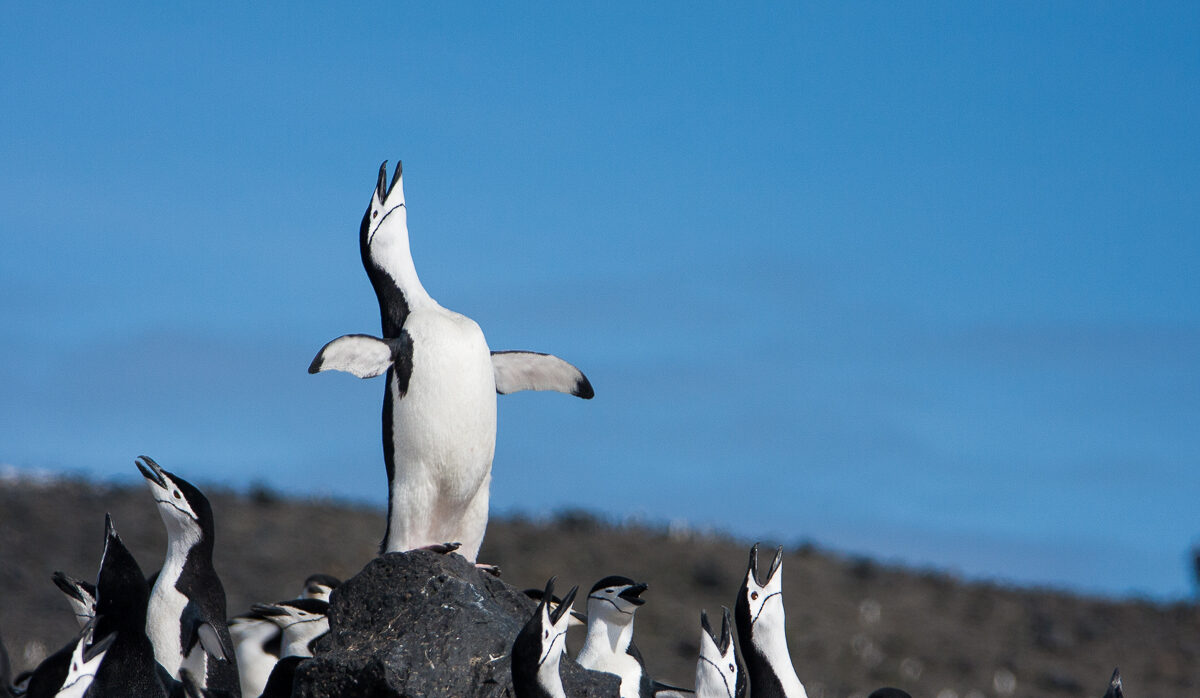
Banner image: Chinstrap penguins feed mostly on krill in Antarctica. Image courtesy of Jay Williams / WWF.
See related coverage:
Antarctic conservation summit closes with stalemate on MPAs & krill fishing rules
Abandoning Antarctic krill management measure threatens conservation progress (commentary)
Norway’s proposal to double krill harvests raises tension at Antarctic conservation summit
Credits

This story first appeared on Mongabay
This article is licensed under a Creative Commons Attribution-NoDerivatives 4.0 International License.
You may republish this article, so long as you credit the authors and Mongabay, and do not change the text. Please include a link back to the original article.



