QR codes have now become a universal tool embedded into the digital infrastructure — from marketing and education to restaurant menus and product packaging. Millions of people scan them every day, while hundreds of thousands of companies and individuals around the world create them.
ME-QR, one of the leading QR code generation platforms, analyzed over 2 million codes created in just the first six months of 2025 — and now we know exactly which types of QR codes are the most popular and which countries are experiencing a real boom in QR creation.
Which QR Codes Are Created Most Often: A Breakdown by Type
QR codes have long evolved beyond being just a tool for scanning links — today, they are an essential part of marketing, education, logistics, and many other fields. The ME-QR platform has collected data on QR code creation in 2025, and we’ve prepared an analytical overview of the most commonly generated types.
QR Code Type Distribution
In the first half of 2025 (January–June), ME-QR users generated millions of QR codes of various types — from classic links to interactive media, documents, and maps. We analyzed the distribution by type and compiled an overview of what users encode most frequently, and which formats remain more niche for now.
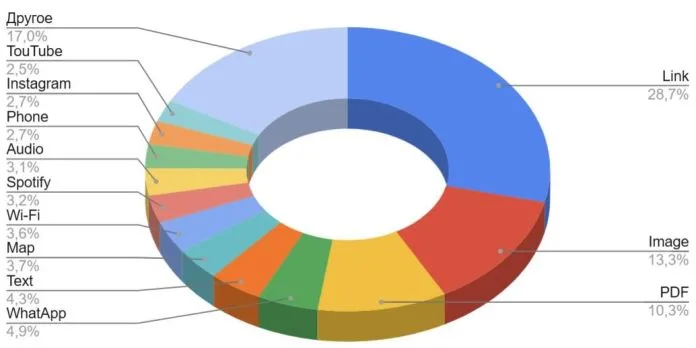
Here’s the breakdown of QR code types by percentage of total codes created during the first six months of the year:
| QR Code Type | Share (%) |
| Link | 28,73% |
| Image | 13,33% |
| 10,31% | |
| WhatApp | 4,87% |
| Text | 4,26% |
| Map | 3,73% |
| Wi-Fi | 3,63% |
| Spotify | 3,16% |
| Audio | 3,09% |
| Phone | 2,74% |
| 2,66% | |
| YouTube | 2,50% |
| Другое | 17,00% |
Key Insights:
- Links remain the kings of QR marketing. Despite the growth of other formats, 28.73% of all QR codes still lead to URLs. This is a universal format — ideal for landing pages, promotions, websites, and ad campaigns.
- Visual formats are rapidly gaining momentum. Images (13.33%) are the second most popular type. This likely points to increased use of QR codes in offline advertising, packaging, and showcasing products/services without extra clicks.
- PDFs rank high in digital document sharing. PDF codes make up 10.31% — companies are actively using them to encode manuals, presentations, contracts, and menus.
- WhatsApp surpasses Email and vCard. Nearly 5% of all QR codes direct users to WhatsApp, indicating the growing popularity of direct messaging in sales and customer service.
- Location, Wi-Fi, and text codes remain a stable niche. Maps (3.73%), Wi-Fi (3.63%), and text messages (4.26%) continue to show consistent demand — commonly used in businesses with a physical presence (cafés, hotels, events).
- Multimedia holds a steady, but non-dominant, share. Spotify (3.16%), audio(3.09%), YouTube (2.5%), and Instagram (2.66%) collectively account for almost 11%, indicating strong interest in interactive content, though without explosive growth — yet.
- “Other” types still hold a significant share — 17%. This suggests both the diversity of use cases (files, TikTok, forms, payment buttons, etc.) and that users are actively experimenting with less conventional QR code applications.
QR Code Type Trends Over Time
Today, users are increasingly encoding PDF documents, Wi-Fi connections, social media links, forms, and even Cryptocurrency addresses.
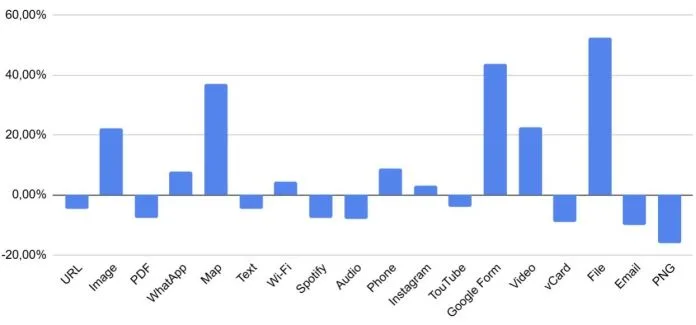
To understand which formats are declining and which are on the rise, we compared the number of scans for each QR code type in Q1 and Q2 of 2025.
| QR Code Type | Dynamics (%) |
| URL | -4,6% |
| Image | +22,2% |
| -7,8% | |
| WhatApp | +7,8% |
| Map | +37% |
| Text | -4,5% |
| Wi-Fi | +4,4% |
| Spotify | -7,7% |
| Audio | -7,9% |
| Phone | +8,7% |
| +3,1% | |
| YouTube | -4,1% |
| Google Form | +43,6% |
| Video | +22,6% |
| vCard | -8,9% |
| File | +52,4% |
| -10% | |
| PNG | -16,2% |
Key Findings:
- QR codes leading to files (+52.4%) and Google Forms (+43.6%) show some of the highest growth rates. This suggests increased usage in business, education, and internal communication. Users value the ability to quickly share information without relying on links or attachments.
- Maps (+37%), images (+22.2%), and videos (+22.6%) are among the fastest-growing formats. These are especially relevant for events, tourism, and local businesses, where it’s important to instantly showcase a location, product, or emotion.
- URL (-4.6%), text (-4.5%), YouTube (-4.1%), and PDF (-7.8%) are experiencing a decline. This may indicate a shift from general-purpose solutions toward more functional and specialized formats.
- Spotify (-7.7%) and audio (-7.9%) show a slight but steady decrease — possibly because these types of codes are less engaging for end users or perform less effectively in marketing campaigns.
QR Code Usage by Country: Which Types Are Most Popular
QR codes have become a part of everyday life for users around the world — but the way they are used varies significantly by region. In some countries, QR codes are mostly used for sharing documents, in others — for linking to websites, while in some regions they’re favored for messaging or Wi-Fi access.
During the first six months of 2025, the ME-QR platform recorded millions of generated codes, and we analyzed behavioral patterns across different countries. What types of QR codes dominate in the different countries? Why are PDFs and forms leading in some regions, while media or maps prevail in others? Below is a detailed analysis based on ME-QR’s statistics, with key insights for each country.
USA
Users from the United States remain among the most active QR code creators on the
ME-QR platform. In the first six months of 2025, they generated a significant number of codes — and we took a closer look at what types of content the American audience is most frequently encoding.
| QR Code Type | Share (%) |
| Link | 21,58% |
| 14,94% | |
| Google Form | 10,15% |
| Image | 8,70% |
| Spotify | 4,60% |
| 3,95% | |
| Google Doc | 3,87% |
| YouTube | 3,84% |
| Text | 3,54% |
| Phone | 2,95% |
| Audio | 2,72% |
| 2,48% | |
| File | 2,14% |
| Другое | 14,55% |
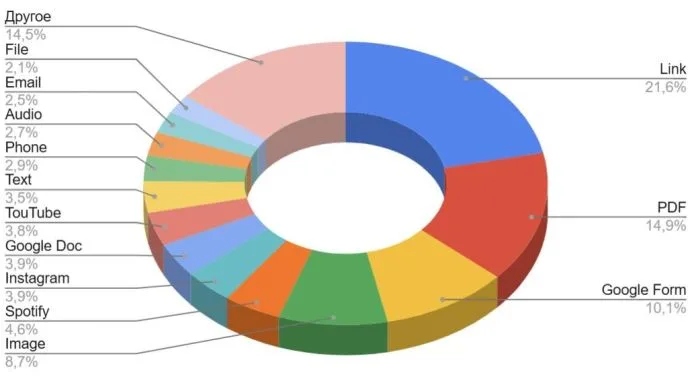
Insights:
- The U.S. leads in using QR codes for digital documents and forms. Combined, PDFs (14.94%), Google Forms (10.15%), Google Docs (3.87%), and files (2.14%) account for over 30% of all QR codes. This indicates that American users actively leverage QR codes to streamline processes in education, HR, internal workflows, and events.
- Simple links are losing ground. Although URLs remain the most popular type (21.58%), their share in the U.S. is notably lower than the global average (nearly 29%). This suggests a shift toward more specialized uses of QR codes.
- A high share of the “Other” category signals diversity. Nearly 15% of QR codes fall under “Other,” which may include bookings, payments, Wi-Fi access, messaging apps, and custom designs. This points to broad experimentation and a drive to explore new ways of engaging audiences.
Spain
In Spain, users actively utilize QR codes to access multimedia content, documents, and music platforms. There is a particularly strong interest in visually adapted solutions and in sharing information in digital formats.
| QR Code Type | Share (%) |
| Link | 26,25% |
| 18,67% | |
| Spotify | 8,66% |
| QR (Customize) | 6,85% |
| Image | 6,17% |
| Audio | 6,17% |
| Video | 5,41% |
| WhatApp | 3,87% |
| YouTube | 3,44% |
| Wi-Fi | 2,45% |
| Text | 2,42% |
| 2,40% | |
| Другое | 7,24% |
Insights:
- The classic format remains on top. QR codes linking to URLs account for 26.25% of the total, reflecting a steady interest in this universal format.
- Music as part of everyday life. Spotify QR codes confidently made it into the top, with 8.66% — higher than in most countries, highlighting the popularity of music content.
- Documents always at hand. Text-based QR codes represent 7.64%, indicating strong demand for quick access to important information — from instructions to personal notes.
France
In France, users actively utilize QR codes to access a wide range of content — from links and documents to videos and audio. This reflects a high level of digital maturity and a readiness to engage with interactive formats. Below are the key insights into the distribution of popular QR code types.
| QR Code Type | Share (%) |
| Link | 44,47% |
| 18,00% | |
| Image | 5,05% |
| Wi-Fi | 4,94% |
| YouTube | 4,10% |
| Audio | 3,98% |
| 3,45% | |
| Text | 2,24% |
| Video | 2,09% |
| PNG | 2,03% |
| vCard | 1,85% |
| Phone | 1,18% |
| Другое | 6,63% |
Insights:
- High share of Link QR codes (44.47%) — significantly above the global average (~29%). French users rely heavily on QR codes for directing traffic to websites, landing pages, restaurant menus, or promotional pages. This suggests a strong habit of using QR codes for external navigation.
- PDF codes take second place (18%) — almost twice the global average (~10%). France stands out for its active use of QR codes to share documents. This may reflect their popularity in education, public services, or offline businesses where price lists, instructions, and forms are commonly shared.
- Video and audio formats are used less than expected. YouTube (4.1%), Audio (3.98%), and Video (only 2.09%) show lower usage compared to countries like
the U.S., despite France’s high digital adoption. This may suggest a preference for sharing media directly or via social platforms, bypassing QR codes.
Brazil
In Brazil, QR codes are more than just a utility — they serve as a full-fledged channel for communication, entertainment, and online access. Local users actively integrate QR codes into their daily lives — from messaging to music streaming. Let’s take a closer look at which types of QR codes dominate in the country and what this might mean for businesses and developers.
| QR Code Type | Share (%) |
| WhatApp | 16,44% |
| 12,71% | |
| Spotify | 12,53% |
| Link | 10,79% |
| 10,46% | |
| Wi-Fi | 9,00% |
| Image | 6,43% |
| Text | 3,62% |
| Audio | 3,22% |
| YouTube | 2,66% |
| Phone | 2,21% |
| Video | 1,96% |
| Другое | 7,97% |
Insights:
- WhatsApp is the clear leader (16.44%). This exceptionally high figure highlights the deep integration of the messaging app into Brazilians’ daily lives. QR codes are widely used here for direct communication with brands, delivery services, and customer support
- PDF and Spotify are nearly equally popular (12.71% and 12.53%). This balance between business and entertainment content reflects the versatility of QR code usage in Brazil. PDFs are used for instructions, tickets, and presentations, while Spotify covers playlists, music releases, and podcasts. It shows a mature approach — QR codes are used not just for work, but for enjoyment as well.
- Low share of Video and YouTube (1.96% and 2.66%). Despite the popularity of video content, video-related QR codes are still underused. This may indicate that most users prefer to access multimedia directly through apps or social media, bypassing QR codes.
Forecast for QR Code Types in the Second Half of 2025
In the second half of 2025, trends in the use of different QR code types will continue to evolve according to local digital behavior patterns, but several global trends stand out:
- Link-based QR codes will maintain their leadership in many countries, especially in places like Ukraine, Thailand, and Argentina, where link redirects remain the primary way to engage audiences.
- Growth in multimedia formats (PDF, Image, Audio, Video) will be observed in countries with advanced digital infrastructure, such as Japan and France. Here, QR codes will increasingly be used to deliver rich content, replacing traditional links.
- Messengers and social networks (WhatsApp, Instagram, Telegram) will continue to integrate actively with QR codes in Latin America and Southeast Asia. Brazil and Indonesia will exemplify this trend.
- Wi-Fi and Payment QR codes are gaining popularity in Indonesia, India, and Brazil, reflecting increased mobility, cashless payments, and development of guest services.
- Customized and non-standard QR code types will gradually increase their share, especially in business and marketing environments, allowing brands to stand out and improve user experience.
Overall, the digital diversity of QR codes will only expand, adapting to the specifics of each market and technological innovations, creating additional opportunities for customer engagement and business process optimization.